Saturday, December 7, 2019

The White Spotted Beauties

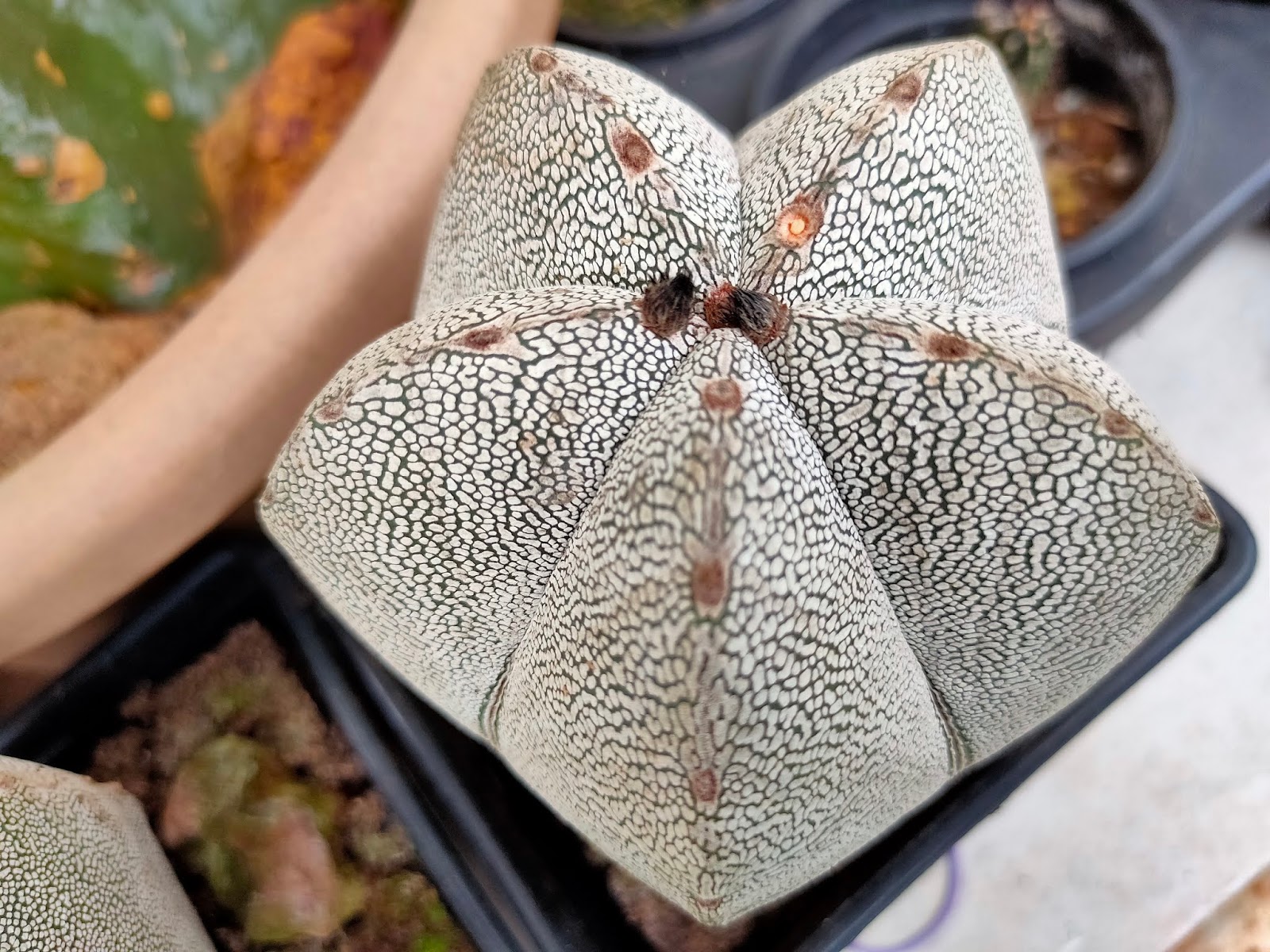
Astrophytum myriostigma
Onzuka

Today, another two new Onzukas were repotted. It was purchased from a Dutch cactus grower through eBay.

Why do I view them as distinctively beautiful?

1.Their round to almost sphere like shape.

2. Unique white spots pattern

3. Permanent and thick white spots

Lo and behold.


Below is the growing guide from Llifle.com

Description: Astrophytum myriostigma is a quite variable species and several breeds do exist. The "Onzuka" is probably the most beautiful, sought after and attractive of all.

The cultivar 'ONZUKA' (In Japanese speaking "Onzuka Ranpo-gyoku") has snowy-white, heavily speckled epidermis with fabulous markings much like the ‘kabuto’ asterias. The white marking varies considerably from plant to plant and there exist an enormous number of different designs, and also plants change their appearance in age and they are full of surprises as they grows.

It was created somewhat by chance in Japan around 1974-1977 by Mr. Tsutomu Onzuka (Hence the name).

He intended to cross a three-ribbed Astrophytum myriostigma with Astrophytum myriostigma var. nudum. Subsequently, over several generations of repeated backcrossed of the the offspring he obtained, unexpectedly, some strange A. myriostigma characterized by large white dots. It has been called 'ONZUKA.' The columnar shape of the older Onzuka comes almost certainly from the tulense variety, a character that should be present in one of its parents

Cultivation and Propagation: Although regarded as a choice and difficult plant in cultivation it is relatively easy to grow. It is sometime seen as a grafted plant but grows very well on its own roots too. Use mineral well permeable substratum with little organic matter (peat, humus). Water sparingly from March till October and keep perfectly dry in winter at temperatures from 5 to 15 degrees centigrade. (but it is Hardy to -7°C for short periods) In the rest period no high atmospheric humidity!! Sun Exposure: Light shade to full sun.

Be careful: The epidermis of ONZUKA is harder than in the normal myriostigmas and cracks easily if plants are overwatered.

Propagation: By seeds, remembering that seedlings dislike strong light and dry conditions and need to be repotted frequently. Eventually, as they become mature, they attain a maximum size of 8-10 cm (20) cm in diameter.

However old plants become senile and have a tendency to succumb to disease and a weak root system. At this stage, as is well known, they die suddenly. So, after they reach 10 cm in diameter grow them slowly, and adopt a new repotting period, using intervals of every 2 - 3 years. Additionally grow them under drier conditions or with stronger sunlight.

But plants are often grafted to accelerate growth as they would generally take at least a five years to reach maturity on their own, but the grafted plants are typical rather tall growing, compared with plants on their own roots that are usually more flat to the ground

Thanks for reading.

Happy growing guys.

Monday, December 2, 2019

How To Bloom Your Cactus: Cereus Hildmannianus

"Weeds Are Flower Too, If You Know ThemA. A. Milne

How To Bloom Your Cereus Cactus?

'Night Blooming Cereus' consists of Selenicereus grandiflorus, Epiphyllum oxypetalum and Hylocereus undatus. 

Cereus hildmannianus / peruvianus is sometimes also considered as 'Night Blooming Cereus' kind of cactus due to 3 main reasons namely:

a)  Very large and fragrant white blooms

b) Short living flower, no more than one day.

c) Night blooming and pollinated by nocturnal pollinator.

So, How Does A Cereus Flower Looks Like?

#  Saturday 30 November


# Sunday 1 Dec


# Monday 2 Dec


# Close Up


How To Induce Blooming Then?

You have two main choices which are either by rooting a mature cutting or growing Cereus to maturity.

The first option sometimes can be easiest, that is how I obtained the picture above.

a) Rooting mature cutting.

Mature Cereus cutting tends to flower right after getting separated from mother plant.

All you need to do is cut a branch and root them, preferably under shade to avoid too much shrinkage from evaporation.

They will put out bloom around a month or two, then will resume growth for another 3 years before reblooming.

In my experiences, 5 to 6 feet long cuttings will pit more blooms over a feet long cuttings, but both will take around 3 years to rebloom again regardless their size.

Maybe that is applicable to my climate. But young cuttings do not bloom at all, just keep growing.

b) Blooming mature Cereus

This is very straight forward, grow cuttings for 3 years or more and once matured, they will eventually bloom. This method will produce better blooms in term of quantity and quality.

Obviously, if you planning to produce fruit for consumption and breeding, this is the option.

Having said so, I have seen people grow Cereus in a condition so bad that it grow very slow and small that blooming the cactus itself is out of question.

To increase your success rate, fertilize  and water the them regularly will produce big and healthy cactus. To induce flowering, stop fertilizer and water when its getting cooler.

This different to Tropical grower, as we do not experience 4 seasons, stop fertilizer and water when the youngest branch turn dark green from green blue color.

Beware!

Cereus is strictly 'self incompatible' which means you need to cross with Cereus of different genetic background. Cutting them into many plants only produce more blooming plants but would not produce fruit.

Here are the pics of my recently rooted Cereus that bloomed few days ago.


Thanks for reading guys.

Don't forget to subscribe.

Happy growing, adieu.

Sunday, December 1, 2019

Grafting Cactus: The Dilemma Of Having Too Many Rootstocks

To Graft or Not To Graft yet


Despite having a lot of Cereus hildmannianus / peruvianus in collection, I am really not that obsessed with Cereus. Probably.

Less than 2 months ago, I hauled a load of Cereus cuttings from my working site. My staffs over there would like to trim down their Cereus. It was tree-like big, maybe a 15 footer Cereus.

Now it was history, all cut up to 2 to 4 feet long cuttings. I got myself around 20 to 25 tip cuttings, they are really thick and big. Around 35 mid cuttings, the biggest cutting is more than 20kg. 


Cereus stockpile under mango tree shade


Selection on today rooting session. Some of it going to be send to a friend.


Two tip cuttings was grafted with Echinopsis variegata. They put out some roots already, so why not.


Coconut for scale. For a 2 feet cuttings, they are very thick.

Long story short, now I have tons of Cereus, tip cuttings for immediate graft (rooted and in 4 weeks ready for grafting) and mid cuttings for future stocks. I have rooted almost all top cuttings and currently spending my weekend relocating the rest into my in law's coconut farm.


Too many rootstocks ?

Depending on my personal point of view, you can never have too many rootstocks. It just that you might not have enough time or scion to do all of it at once.

At the moment, I have 2 pots full of Echinopsis variegata scions and and two newly acquired cactus species namely Lemaireocereus pruinosus / Stenocereus pruinosus and Neoraimondia herzogiana.


You can view my post about them here:

Neoraimondia herzogiana

Lemaireocereus pruinosus / Stenocereus pruinosus

These guys are more than enough to be grafted for a month or two. My plan for Echinopsis is to grow them big and increase their number mainly from offsets. 

Stenocereus pruinosus might be for different purposes. I want to graft them on Hylocereus or Acanthocereus to fasten their growth and eventually will be used as rootstock for Ariocarpus / Astrophytum.

For now, I will wait for them to be ready for another round of grafting. They are pretty quick to resume growth.


Good thing about rooting Cereus is they love to pop some blooms especially from mature cuttings. Cereus produce shortliving flowers that bloom during the night. But if lucky enough, you can  observe their outstanding 15 to 20cm inflorescence.


In conclusion, other than as grafting stock, Cereus could serve well as garden fence. They are fastgrower and produce beautiful flowers. If I do  not use them for grafting, they will be very useful for blocking pest in the farm.

That's it for today, happy growing guys!